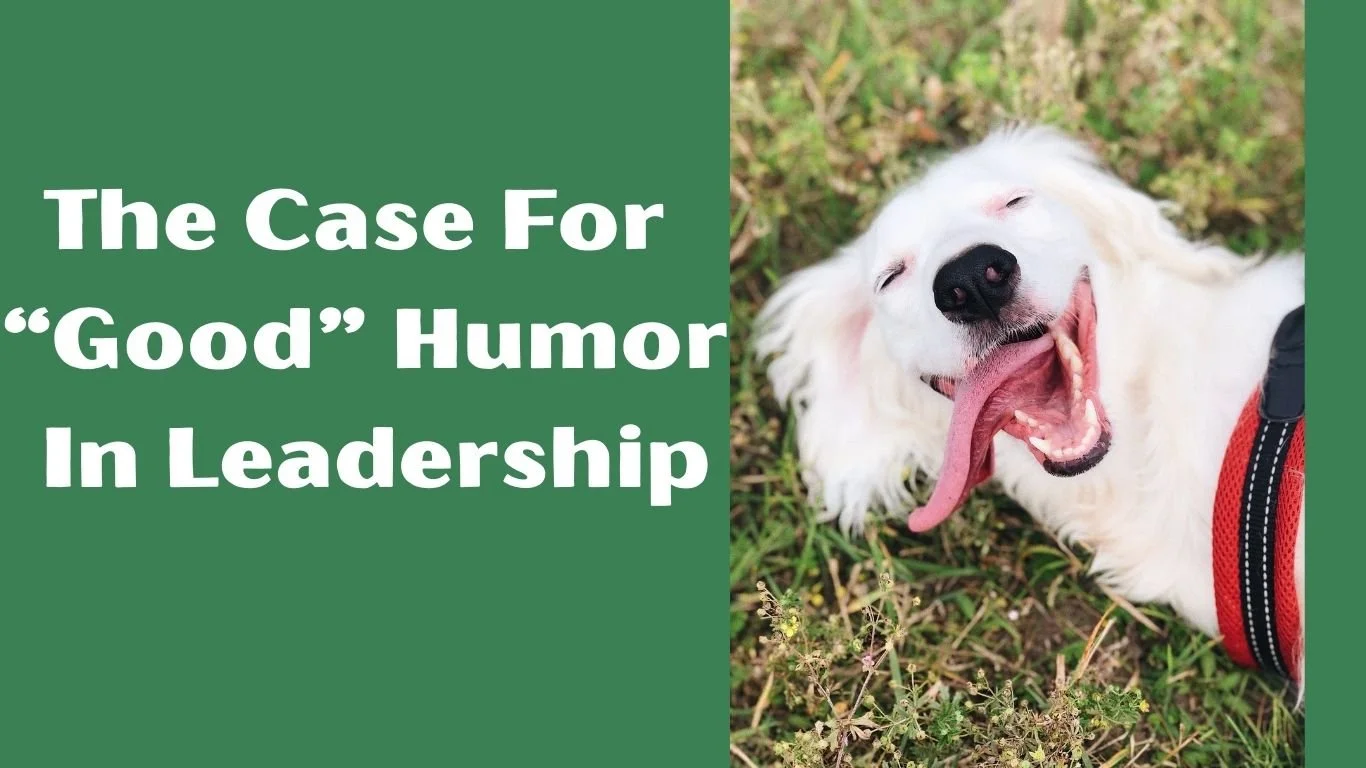
Green background with smiling white dog on the right side of the photo with the text “The Case For “Good” Humor In Leadership” on the left side
A little while back, I delivered a talk on the power of humor as a leadership strategy. It’s one of my favorite topics, partly because I’m very funny.
Seriously, I’m a freakin’ riot.
I believe in and use humor as my personal infrastructure. Life is hard. Sometimes it’s damn hard, and without a metaphorical skeleton of funny bones, life would be too impossible to get through.
Humor is one of the ways in which humans bond. The chemical reactions in our bodies when we find something amusing is robust, powerful and creates connection. It’s literally essential to our species to laugh together.
In the talk, I provided examples of leaders of companies and countries who had used humor, both positively and negatively, in their leadership styles. In one positive example, I highlighted Mary Barra, CEO of General Motors, who is renowned for her empathetic, humorous and lighthearted approach to even the most difficult situations. I showcased Abraham Lincoln, who leaned into self-deprecating humor to diffuse a tense heckler situation during an important speech.
I also shared examples of humor being used in a negative ways. One way being to insult or punch down at people with less power than themselves under the guise of a “joke.” An example I detailed is Michael O’Leary, CEO of Ryanair, who has been often quoted as “jokingly” insulting both customers and employees. Another was the former President of Brazil, Jair Bolsonaro, who frequently made cruel and misogynistic comments, and who not unimportantly, is now in prison. Make of that what you will.
AND, I used President Donald Trump, who during a rally, famously mocked handicapped journalist, Serge Kovaleski.
At no point during the talk did I express any political beliefs, leanings or ideology. In fact, I specifically commented that none of the examples I shared were political, only that the person’s actions or comments were specifically relevant to the subject of humor in leadership.
It was a pleasure working with the organizers and delivering this content. I thoroughly enjoyed myself and felt that I brought real value and insight to the event. The post-event feedback I received was overwhelmingly positive; almost perfect scores.
Almost.
Two respondents took umbrage to my use of Donald Trump as a negative example. One person commented that even though I said it wasn’t political, just using him was political. I’m still marinating on that…
The second person also thought that I should not have used Donald Trump as a negative example, or if I did, I should have also used one “…from the other side.” Frankly, that comment has me stumped. It’s unclear to me what exactly this person meant. I assume they meant Democrat, as the other side of Republican? That I should have found an example of a Democratic leader who as consistently and constantly punches down as Mr. Trump?
But here’s the rub with that train of thought… I don’t believe that right and wrong are the sole purview of Democrats or Republicans. What Mr. Trump did was wrong. What he did had nothing to do with him being a Republican. He, the person with the power, punched down on someone with no power, in order to make people laugh and to curry favor with the crowd. What is the other side of that? On the playground, we would call that bullying.
Of course, we’ve recently seen footage of Mr. Trump insulting a reporting who asked a question by admonishing her to be “…quiet, piggy.” Is there another side to that?
Leaders, any leaders who publicly insult others, make cruel or outlandish comments, or treat people with wanton disregard, are not leaders who inspire. People who lead with humor well, train their eye on themselves first. They’re vulnerable, because they’re strong. They’re self-deprecating because they know they’re imperfect. They ask questions because they’re confident they’ve got people around them who know the answers, even if they themselves don’t. They aren’t afraid to make a mistake and own it. And finally, they don’t have to belittle others in order to make themselves feel powerful.
I use humor because life is damn hard and I want to wring all the fun and joy from it I possibly can. Using humor as a leadership strategy is like taking the Hippocratic Oath: First, do no harm.
If you have to tell someone that “…it’s just a joke…” then you’re doing humor wrong.
LB Adams is the CEO of Practical Dramatics, LLC and is a contributor to Forbes and Entrepreneur. A keynote speaker known for her theatre-based teaching style, she helps organizations communicate better, one conversation at a time.