5 Lessons From The Theatre That’ll Get You Through Life
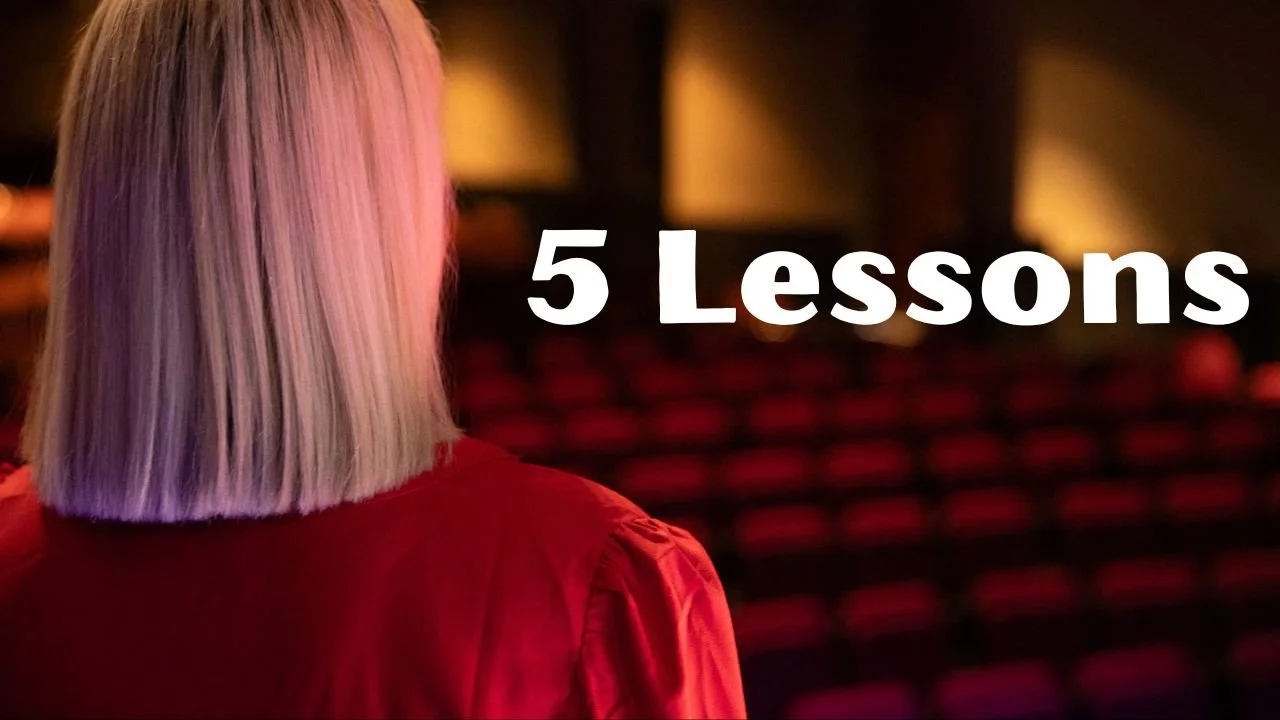
Back of the head and shoulders of a blond woman looking at an empty theatre.
As I’ve grown older, it never ceases to amaze me how many life lessons I learned as a novice actor. My acting teachers, the directors, casting agents, and stage managers have all the combined wisdom of the ages. Too bad I was too young, too blind, and too full of myself back then to really understand the gifts I was being given.
I get it now though… And while the life lesson list could be much longer, here I offer you the five most important lessons my acting teachers taught me that have gotten me through life, so far:
1. Speak up. Speak out.
Articulate and project! Don’t mumble, don’t stare at your shoes. Don’t talk over people. If you feel the impetus to speak, then say the words clearly and confidently when it’s your turn to speak. Notice how I prefaced the last sentence with the word “IF.” That was purposeful. Not every situation requires you to speak. Not every word that falls from your lips is gold. Know when to speak. AND THEN, articulate project, and connect.
2. Know your blocking.
In the theatre, where and when you move and stand, is called “blocking.” In life we constantly have to check in with ourselves and ask, “Are you in the right place?” “Are you occupying the space you need to be?,” and most importantly, a”Are you making moves that propel your story where you want it to go?” Sometimes we make a move so that we feel like we’re doing something, but are we? Are we actually moving with purpose? If you don’t know where you’re going, if you find you’re someplace you’re unhappy with, stop moving, breathe, and figure out what the next right move will be. Blocking, all blocking, exists to move your particular story along.
3. Find your light.
On stage, if you’re standing in the dark, the audience can’t see you, and if you’re speaking while in darkness, much of the impact of what you’re saying is lost since we can’t see the the full person. In your life, finding your light is finding where YOU shine. What lights you up as a person. What, in particular, is it that YOU do? What skills and abilities do you possess? How do you matter to the world? Let me quickly share with you my very unscientific theory of humanity. We’ve all heard the metaphor that humans are onions with lots of layers, right? I don’t think you’re an onion - I think you’re a disco ball. Because it’s multi-dimensional, multi-faceted, you can’t EVER see it all at one time. You see parts, bits, depending on the situation. And a disco ball needs to find the light to do what it was created for. Disco balls cannot fulfill their purpose in the dark. And because you are a disco ball, you must find your light, whatever that is, and activate from there.
4. Try it this way.
One of the most interesting, fun and scary things an acting teacher or director can say to you is, “That was great, but try it with an English accent,” or “Try it like you hate him,” or “Try smiling when you say that line.” The process of rehearsal isn’t ever about finding perfection, it’s about finding what works in the moment; what serves the text, the characters and the show. It’s about the freedom to play and to learn. To try things on, to get it wrong and do it again, and again. The only certainty in life is change. Growth is sometimes hard and usually uncomfortable. Once we begin to move out of childhood, we adults are so busy adulting, that we forget to try new things, or that we can do them differently. Sparks don’t come from doing it the way you’ve always done it, neither does growth. Magic happens when we step outside of our self-imposed bubble.
Sometimes we’ll absolutely hate it.
Once in a while we stumble into excellence.
And we’ll always get to learn something about ourselves.
5. The show must go on.
We’ve all heard this before - it’s an old one and a good one, particularly in live theatre. Baring death, and maybe not even then, the show must go on. It doesn’t stop because someone missed an entrance - you cover. It doesn’t stop because someone skipped three paragraphs of dialogue - you figure it out. And it certainly doesn’t end because someone forgot their lines. The world doesn’t stop for you. Even in the deepest regions of grief, the world still turns and people still are shopping for cucumbers, getting hair cuts, and arguing on social media. This is about adapting to whatever comes your way. You don’t get to stand unchanged while the world moves around you. It’s not just that the show MUST go on, it’s that the show WILL go on and you must negotiate your way forward in it. “All the world’s a stage, and all the men and women merely players.”
As I said, I could list many, many more of these theatrical wisdoms, but here’s one bonus bit of enlightenment:
6. Listen, always, to the whole person.
In the theatre, we run on a script of words, and in live theatre, no two shows are ever the same.
EVER.
Because people.
People bring energy and emotion, and sometimes we show up half way, and sometimes we are soooo extra. People are NEVER all words. We are nonverbal creatures. What we do with our bodies, our expressions, our posture, our clothes, all tell the story. I once was working with a Russian director who was translating several of his own works from Russian to English. In this particular scene, I was playing a young Russian prostitute who was destitute. The stage direction was “She enters and takes off her coat.” So, I entered, unbuttoned the coat and tossed in on a chair. The director stopped the scene, and said to me, “This is your only coat. You have no money. It’s freezing outside. If something happens to your coat, you will die. How will you handle your coat if you know that it is the only thing standing between you and death?” If you observe someone casually toss their coat, or fold in neatly and carefully, both tell a story. Both are communicating very different insights into the person. If you can listen, not only to the words that people say, but what they don’t say, how they move, how they make eye contact, how they handle and treat things and people. If you can be a listener of people, to the totality of a person, it can be your super power.
LB Adams is the CEO of Practical Dramatics, LLC and is a contributor to Forbes and Entrepreneur. A keynote speaker known for her theatre-based teaching style, she helps organizations communicate better, one conversation at a time.